
Adapting-Not Quitting!

February 2019 No. 55
Adapting - Not Quitting!
Judy Colditz, OT/L, CHT, FAOTA
Some patients love doing repetitive activities, but such activities can irritate soft tissues and contribute to joint pain and deformity. Because they love it, they do not want to give it up! The answer is not about giving up activities — it is about changing the forces and working smarter.
Our example is a 72-year-old female, obsessed with needlepoint, which causes MP and PIP joint swelling of the right long finger (needle hand) as well as a snapping at the PIP joint of that finger. She is most bothered by the snapping at the PIP joint when she flexes the finger, and does not even realize there is a problem at the MP joint of the right long finger. Additionally, the MP joint of the left index finger (holding hand) is inflamed and swollen. She admits to hours of non-stop needlepointing!
As she needlepoints, she displays an ulnar directed load on the right long fingertip when she pushes the needle through the canvas and also shows an ulnar directed load on the left MP joint while she holds onto the canvas.
After an initial two weeks of rest from the activity, she used a timer to assure she spent 30 minutes resting between each 30 minutes of needlepointing. She ices when there is a hint of inflammation. The snapping at her right long finger PIP joint (which was caused by the radial lateral band snapping over the condyle due to the MP joint ulnar deviation) has resolved.
To assure she can continue this activity as she ages, she was fitted with two custom orthoses. The right-hand orthosis is a modified figure of eight design made with Fabrifoam®. This design provides a radially directed support that is flexible and has soft edges, which makes it comfortable as she moves her long finger. Making this orthosis requires sewing the material together, as well as sewing the hook and loop on the material to create a closure.
The left hand is fitted with a thermoplastic molded orthosis to provide firmer support to the index finger MP joint, so it is not constantly pushed in the ulnar direction. She wears these orthoses only when needlepointing.
This is only one example of the many custom orthotic designs that can modify a favorite activity, so our patients can adapt and not quit.
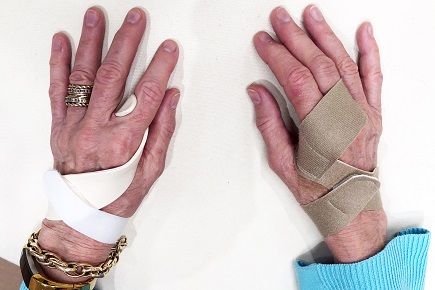
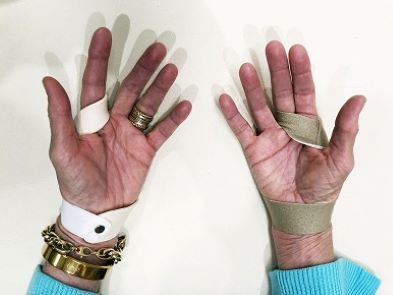
Dorsal and volar views of orthoses on both hands

Orthosis prevents ulnar deviation at the MP joint of the right hand when pushing the needle
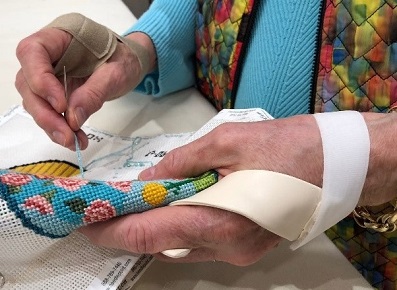
Orthosis prevents ulnar deviation at the MP joint of the left hand when holding canvas
Download Clinical Pearl No. 55, Adapting-Not Quitting!, February 2019
© HandLab; 2019 all rights reserved
Disclaimer: HandLab Clinical Pearls are intended to be an informal sharing of practical clinical ideas; not formal evidence-based conclusions of fact.