
Exercises for the Aging Hand: What is Missing?

August 2023 No. 80
Exercises for the Aging Hand: What is Missing?
by Judy Colditz OT/L, CHT, FAOTA
An online search for “exercises for the aging hand” finds numerous videos demonstrating active hand exercises for finger flexion/extension and thumb opposition. Although hand exercise and finger weight lift training help the elderly maintain self-care abilities, exercises for the hand should also consider the anatomical changes that frequently evolve with aging. Stretching and range of motion exercises should assist in keeping our hands functional by minimizing the deforming forces caused by growing older.
Common Anatomical Changes in the Aging Hand
Limited Interphalangeal (IP) Joint Flexion with Limited Metacarpophalangeal (MP) Extension
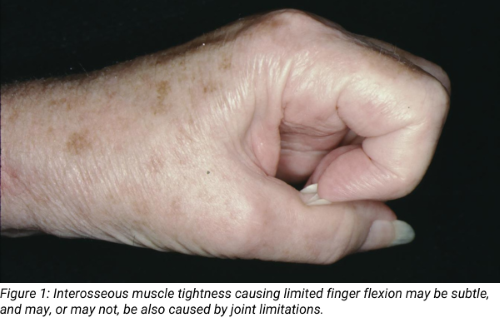
• Aging reduces tissue elasticity, including muscles, and the interosseous muscles are most vulnerable because of their short fiber length. See Figure 1. Tight interosseous muscles limit full finger flexion and if the interosseous muscle tightness advances, it can also limit metacarpophalangeal (MP) joint extension.
Ulnar Deviation and/or Ulnar Dislocation of the Extensor Digitorum Communis (EDC) Tendon over the MP Joint
• Fingers deviate at the MP joints far more in the ulnar direction than the radial direction, creating greater ulnar-sided interosseous tightness. Perhaps this contributes to the idiopathic MP joint ulnar drift seen in elderly hands?
• If ulnar drift continues, dislocation of the EDC over the MP joint may occur. See Figure 2. MP joint deviation and/or EDC dislocation robs the hand of full finger extension, allowing the interosseous muscle tightness to increase even more.

Adducted and Flexed Thumb
• The strong adductor pollicis (AP) brings the elderly thumb into adduction and flexion at the carpometacarpal (CMC) joint. Because of the inherent instability of the thumb CMC joint, thumb adduction/flexion encourages CMC joint dorsal subluxation/dislocation.
The Recommended Stretch Position
Every day, as part of my exercise routine, I actively stretch into the maximum finger and thumb hook position; see video. The hardest part is holding my fingers in a hook posture while simultaneously keeping my MP joints in maximum radial deviation. Aging hands that have not yet developed limitations/pathology can benefit most from this key active stretching exercise. I believe this daily posture will contribute to my aging hand remaining functional as long as possible.
Video: Stretching Exercises (Click to Watch)
Why This Position?
FINGERS: Active hook position with fingers held as far radially as possible
• This assures maximum interosseous muscle elongation of the ulnar sided interossei which are normally the tightest muscles.
• The accurate active hook position (maximum MP extension/hyperextension & full IP flexion) achieves several other goals:
1. Maximum elongation of the lumbrical muscles
2. Maximal glide of the flexor digitorum profundus (FDP) and the superficialis (FDS) within zone 2
3. Maximal differential glide of the FDP and FDS within zone 2
4. Maximal flexion of the IP joints
5. Stimulation of lymphatic flow in the fingers
6. Strengthening MP joint extension by engaging the EDC
THUMB: Active hook thumb position (hold the thumb MP and IP joints flexed while extending/abducting the CMC joint)
• The advantage of an active hook position for the thumb includes:
1. Maximum extension and abduction of the thumb CMC joint
2. Elimination of the extensor pollicis longus influence as a CMC joint adductor
3. Elimination of thumb MP or IP joint hyperextension substituting for CMC joint extension/abduction. Although the thumb may not look maximally abducted in this position, the CMC joint is in maximum abduction and extension. See video
• Thumb adduction/flexion are stronger than thumb abduction/extension so it is logical that thumb exercises should focus on extension/abduction. If an adduction contracture is already present (which likely includes pathology of the thumb CMC joint), active exercises may be unsuccessful in creating change.
Recommended Finger Exercises for Interosseous Muscle Tightness
If altered anatomy or pathology is already present, the active hook exercise cannot be effectively executed. Especially in the presence of significant interosseous muscle tightness, it is impossible to fully flex the IP joints and simultaneously bring the MP joints into full extension (preferably hyperextension) because the EDC is not strong enough to overcome the interosseous muscle tightness.
Commonly, when attempting the active hook, IP finger flexion simultaneously brings the MP joints into slight flexion. See Figure 3. The MP joint flexion is subtle and thus often missed. Allowing even slight MP joint flexion does not remediate interosseous muscle tightness.

We recommend three possible approaches for interosseous muscle tightness in the older hand:
• If the patient has significant interosseous muscle tightness, active exercise will not be successful unless the MP joints are held in extension by an exercise orthosis. See Figure 4. The EDC is not strong enough to hold the MP joint hyperextended against interosseous muscle tightness. An exercise orthosis allows active IP joint flexion to elongate the interosseous muscles and the patient may be able to progress to one of the exercises below.

• Place a dot on the middle of the pulp of each fingertip and a dot in the middle of the proximal volar finger crease on each finger. Ask the patient to touch the dots together. Although this is physically impossible for many, attempting to touch the dots requires simultaneous maximum IP flexion and engagement of the EDC to pull the MP joints into maximum extension. In many cases, "touching the dots" can convert an inadequate active hook exercise into a productive one.
• If the patient is not able to engage MP joint extension when “touching the dots,” it may be helpful for the patient to hold a straight edge against the metacarpals (see Figure 3), endeavoring to bring the MP joints into neutral extension by touching the straight edge. This provides visual feedback for full MP joint extension by assuring EDC engagement. By improving this exercise, the patient may then be able to execute the “touch the dots” maneuver.
Exercises to Avoid
Strengthening
Squeezing a ball or putty is the classic recommendation for increasing hand strength. A more productive exercise is isometric squeezing of a firm, medium size, cylindrical object. This allows the fingers to exert force before they reach the closed pack position of full flexion, and the thumb is held out of the palm by the cylinder. Isometric squeezing of the cylinder provides strengthening resistance without loading the joints through range, a much kinder approach to the aging hand. Repeated squeezing into full flexion can lead to development of trigger finger and/or exacerbate carpal tunnel symptoms.
Thumb Touching Fingertips
Most hand exercises recommend actively touching each fingertip with the thumb tip. Often included is touching the base of the little finger with the thumb tip. I cannot think of any functional activity that requires me to touch the tip of my thumb to the fingertip of my ulnar three fingers, so I am unsure what this exercise achieves.
Any exercise that asks the thumb to adduct and flex across the palm leverages on the thumb to generate a dorsal subluxation/dislocation force at the CMC joint. Instead, an isometric exercise that supports the thumb CMC joint in extension and abduction is the more desirable choice.
Download Clinical Pearl No. 80, Exercises for the Aging Hand: What is Missing?, August 2023
© BraceLab; 2023 all rights reserved
Disclaimer: BraceLab Clinical Pearls are intended to be an informal sharing of practical clinical ideas; not formal evidence-based conclusions of fact.