
More Than Just A Side Effect: Identifying & Treating Chemotherapy-Induced Peripheral Neuropathy

April 2020 No. 61
More Than Just A Side Effect: Identifying & Treating Chemotherapy-Induced Peripheral Neuropathy
Karol Young, OTD, OTR/L, CHT
Chemotherapy-Induced Peripheral Neuropathy (CIPN)(1, 2) is caused by cancer medication/s that harm healthy cells, causing neuropathies. Especially vulnerable are the sensory fibers of longer nerves. With progress in cancer treatment, we are seeing an increased number of patients with CIPN in our clinic.
Steve, 62 years old, was referred for therapy following a right shoulder dislocation resulting from a fall at home. During the OT evaluation Steve reported he was receiving chemotherapy and had noticed progressive worsening of pain and numbness in his hands and feet, as well as a decreased ability to hold objects in both of his hands. Once CIPN was suspected, the evaluation and treatment not only addressed Steve’s shoulder dislocation, but also his sensibility and balance impairments.
Traditional sensibility exams such as two-point discrimination and Semmes Weinstein monofilament testing, which track sensory loss/return, may not be helpful with CIPN patients with dysesthesia. Developing a checklist of functional difficulties specific to the patient may serve as the most useful way to document sensory changes. Examples are difficulty fastening buttons, holding on to a coffee cup, opening containers, and typing. It is also useful to document whether the patient can discriminate between hot and cold, varying textures, and the pressure of weighted objects.
Since Steve had fallen, a quick screen using the 4-Stage Balance Test(3) was performed (See Image 1). Steve was unable to perform a tandem stance and reported difficulty feeling his feet when he attempted to place one foot in front of the other. The 4-Stage Balance Test indicated that he was at risk for further falls. Other useful balance tests that can be used are the Timed Up and Go (TUG) Test,(4) and the Modified Clinical Test of Sensory Interaction in Balance.(5)
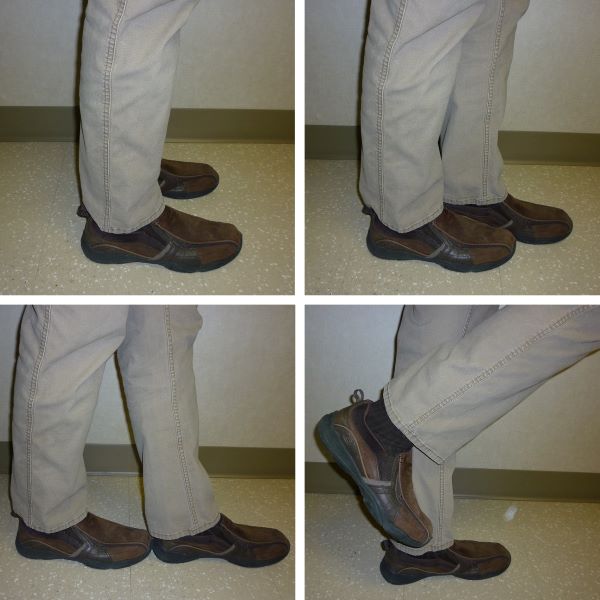
1. The 4-Stage Balance Test stance positions.
Steve’s treatment for CIPN included a home sensory re-education and desensitization program with texture identification (with and without vision), identification of weighted objects (with and without vision), and sensory stimulation progressing from soft to rough textures as each texture was tolerated (See Image 2).
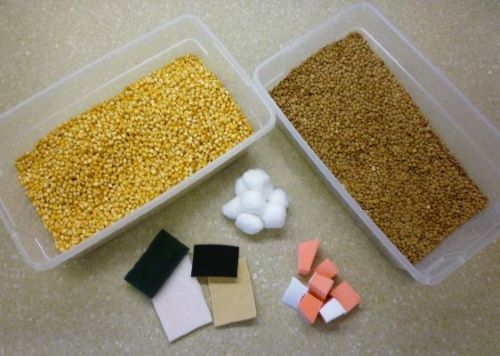
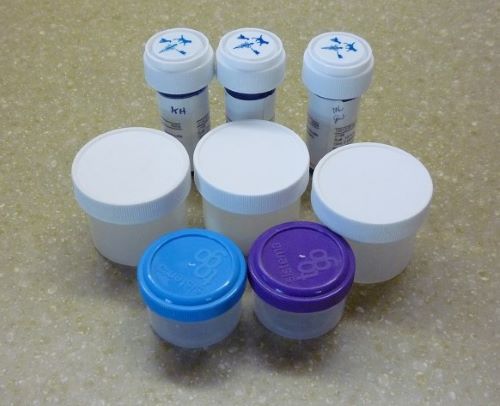
2. Textures and weighted objects used for sensory re-education.
Paper tape was placed over his fingertips to alleviate hypersensitivity when typing and padding was added to tool handles to decrease the pain experienced with tight gripping (See Image 3). Steve’s balance deficits resulted in a referral to our physical therapist, an oncology specialist, for further evaluation and treatment.
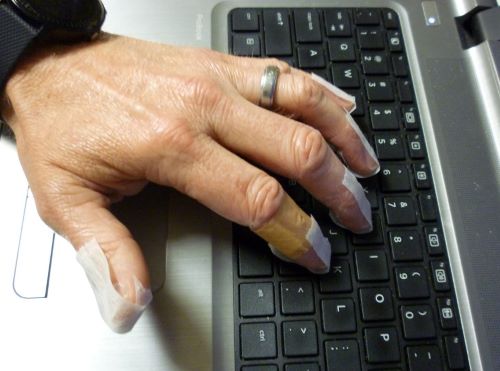
3. Paper tape placed on fingertips to decrease hypersensitivity.
The symptoms of CIPN can change throughout chemotherapy treatment and may even occur after treatment has ended. The length of time that it will take CIPN to resolve depends upon the patient and the medications used. You may be the health care professional who identifies CIPN symptoms, as patients often assume sensory impairment is an unavoidable and untreatable medication side effect. Intake information should screen for a cancer diagnosis and, if present, should alert you to expand your evaluation. Once Steve understood the extent of his sensory impairment, he discussed his CIPN with his oncologist which prompted exploration of alternative chemotherapy.
References
1. Zajaczkowska R, Kocot-Kepska M, Leppert W, Wrzosek A, Mika J, Wordliczek, J. Mechanisms of chemotherapy-induced peripheral neuropathy. International Journal of Molecular Sciences. 2019; 20(6), 1451; https://www.mdpi.com/1422-0067/20/6/1451
2. Kim PY, Johnson, CE. Chemotherapy-induced peripheral neuropathy: A review of recent findings. Current Opinion in Anesthesiology. 2017; 30: 570-76.
3. https://www.cdc.gov/steadi/pdf/4-Stage_Balance _Test-print.pdf
4. https://www.sralab.org/rehabilitation-measures/timed-and-go
5. https://geriatrictoolkit.missouri.edu/balance/ 204Lmctsib.pdf
© BraceLab; 2020 all rights reserved
Disclaimer: BraceLab Clinical Pearls are intended to be an informal sharing of practical clinical ideas; not formal evidence-based conclusions of fact.