
Living the Supinated Life: Solutions for Ulnar Sided Wrist Pain

June 2019 No. 57
Living the Supinated Life: Solutions for Ulnar Sided Wrist Pain
Karol Young OTD, OTR/L, CHT
Recently my coworker Kim, a physical therapist, underwent arthroscopic debridement to the triangular fibrocartilage complex (TFCC) in her right dominant wrist. Like many individuals with TFCC symptoms, she experienced chronic ulnar sided wrist pain with gripping and weight bearing activities but could not remember a specific injury to explain her symptoms. Due to the pain that limited Kim’s ability to participate in weight bearing activities, she decided to undergo surgery. After arthroscopic debridement of the central portion of her TFCC, goals of treatment were to ensure a stable wrist while achieving a pain free range of wrist motion and strength required to perform her activities of daily living, including return to work as a physical therapist. The literature suggests that 40 degrees of wrist flexion and of wrist extension, as well as 40 degrees of combined radial and ulnar deviation, is required for most functional activities.(1)
Kim chose to perform most of her rehabilitation on her own. The importance of wrist stability over flexibility was stressed, along with the arc of motion goal being based upon her activity level. Reviewing the dynamic anatomy of the distal radioulnar joint explained how the position of the ulna changes during rotation, impacting the TFCC as it stabilizes the distal radioulnar joint (DRUJ) and separates the ulna from the carpal bones. Using the skeletal model one can see that when the forearm rotates into pronation while gripping, the ulna shifts positively (forward) and can increase the load to the ulnar side of the wrist by 20%. Conversely, when the forearm is supinated and the fingers are not gripping, there is a negative shift which unloads the ulna.(2) This concept played an important role in Kim’s rehabilitation as she slowly progressed with gripping activities—first in supination, then in neutral, and lastly in pronation in order to limit the load to her healing TFCC.
After surgery, Kim was fitted with a custom fabricated orthosis for protection of the TFFC (see Image 1). Around two weeks post-op, per her physician’s order, Kim began gentle active wrist motion out of the orthosis, with the forearm in neutral, using a small arc of motion while performing the dart thrower’s motion and gently wringing a wash cloth.(3) Over four weeks, while pain free, Kim progressed from active, to active-assistive, then to gentle passive wrist and forearm motion as she began to increase the combined motions of pronation and gripping.

A custom orthosis for the protection of the TFCC
Unfortunately, surgical debridement for degenerative TFFC tears caused by ulnocarpal abutment may not fully relieve ulnar sided wrist pain. At six weeks post-surgery, after returning to work, Kim developed ulnar-sided wrist discomfort when performing manual therapy and documentation, both of which required the combined movements of pronation and ulnar deviation, loading her TFCC.
Kim now uses a split keyboard to avoid maximum pronation and wears a light sport wrist support she finds increases her comfort while performing manual therapy (see images 2 through 4). In a few weeks Kim will determine further treatment options with her physician but now continues to approach activities from a supinated or neutral forearm position, realizing the negative effect gripping in pronation has on her TFCC.

Use of a split keyboard to minimize pronation and ulnar deviation

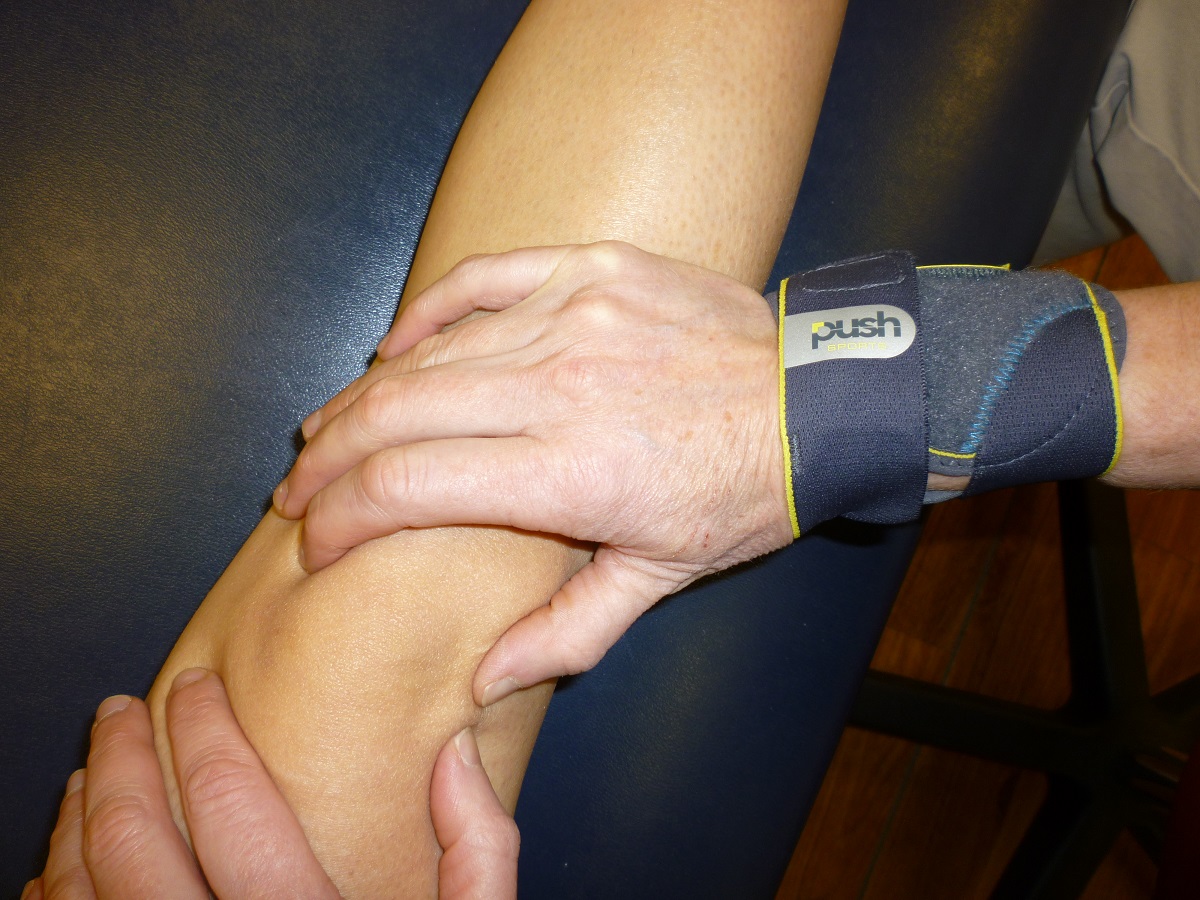
Use of a light sports wrist support to increase comfort while performing manual therapy
References
1. Ryu J, Cooney WP, Askew LJ, et al.: Functional ranges of motion of the wrist joint. J Hand Surg. 16A:409-419 1991
2. Tomiano MM: The importance of the pronated grip x-ray. J Hand Surg Am. 25:352-357 2000
3. Werner FW, Green JK, Short WH, Masaoka S: Scaphoid and lunate motion during a wrist dart throw motion. J Hand Surg. 29A:418-422 2004
Download Clinical Pearl No. 57, Living the Supinated Life: Solutions for Ulnar Sided Wrist Pain, June 2019
© HandLab; 2019 all rights reserved
Disclaimer: HandLab Clinical Pearls are intended to be an informal sharing of practical clinical ideas; not formal evidence-based conclusions of fact.