
Multiple Measurements to Assess the Thumb Web Space

May 2026 No. 96
Multiple Measurements to Assess the Thumb Web Space
by Karol S. Young, OTD, OTR/L, CHT
The thumb drives a remarkable amount of hand function, so even a small loss of motion has a major effect on daily life. One structure often overlooked is the first web space—the soft tissue span between the thumb and index finger. This space is essential for grasping and handling everyday objects such as a steering wheel, bottle of juice/milk, or coffee cup. Clinicians have long debated how best to measure the thumb first web space to evaluate the need for and the outcomes of surgery and therapy.
Measuring the Thumb First Web Space
Traditional thumb goniometry measures flexion and extension at the interphalangeal (IP) and metacarpophalangeal (MP) joints, as well as palmar and radial abduction at the carpometacarpal (CMC) joint when aligning with the first and second metacarpals. These measurements describe thumb motion, but do not always capture the full functional status of the first web space.
Some clinicians consider palmar abduction the preferable measurement because it reflects thumb position during functional grasp. See Figure 1. Others favor radial abduction because it provides a more consistent way to assess the web space angle. (See Figure 1.)

Figure 1: Position for measuring palmar abduction.
Others favor radial abduction because it provides a more consistent way to assess the web space angle. (See Figure 2.) Current literature shows that no single method has been universally accepted, and definitions of a “functional” first web space vary across studies.

Figure 2: Measuring the intermetacarpal distance for thumb radial abduction. Image retrieved from PudMed Central.
In clinical practice, assessment should go beyond joint range of motion alone. A complete evaluation should include:
• Web space angle, measured during thumb palmar abduction
• Web space width or depth, measured during thumb radial abduction
• Web soft tissue extensibility if scar, contracture, or fibrosis is present
• Functional pinch and grasp, to demonstrate how the measured thumb web restriction/s affects hand use
This broader approach is important because static measurements do not always reflect real-world hand performance.
What is the Best Way to Track Progress?
The most useful measurement method depends on the condition being treated. No single measurement number tells the full story, so the most useful approach combines objective measurement with functional assessment.
Thumb CMC Joint Osteoarthritis
In thumb CMC joint osteoarthritis, first web space narrowing may develop over time because of an adduction posture, joint collapse, pain, and/or muscle imbalance. For these patients, the most practical way to track progress is to access:
• Thumb radial and palmar abduction measurements
• Observation of first web space posture
• Pain rating
• Functional measures, such as pinch and grip strength, as well as patient-reported hand use
This multi-measurement approach is more useful than relying on web space appearance alone. (See Figure 3.) Clinical evaluation in thumb base osteoarthritis should include impairment measures and functional outcomes, since isolated physical findings may not fully reflect the patient’s limitations.
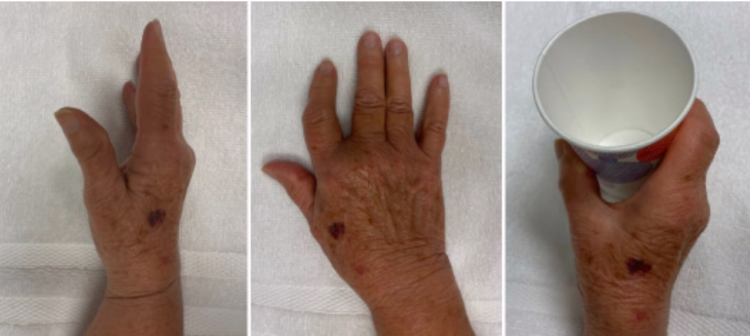
Figure 3: Thumb web space in individual with CMC osteoarthritis. Left to right: Palmar abduction, radial abduction, and functional grasp.
Thumb Web Space Contracture After Burn
In a thumb web space contracture caused by a burn injury, tracking progress should focus on both joint motion and scar restriction. (See Figure 4.) The most useful approach is to document:
• Thumb radial abduction and palmar abduction
• Scar extensibility
• Side-to-side comparison: tracing the injured hand outline with palm flat on paper or serial photographing the hand in the same position
• Functional grasp and release
• Patient-reported difficulty with daily tasks such as the Quick Dash or PRWHE
A burn thumb web contracture affects not only joint motion, but also tissue compliance and the ability to open the hand for functional grasp. In severe cases, studies on first web space contracture release show that outcomes should also be assessed by function, not just correction of the deformity.

Figure 4. A thumb web space contracture due to a burn.
Thumb Web Space Deficit due to Ulnar Nerve Palsy
In ulnar nerve palsy, thumb web space problems relate less to scar or joint restriction and more to muscle imbalance which creates a loss of thumb stability for key pinch because of the loss of active thumb adduction. (See Figure 5.) In these cases, the most useful way to measure and monitor progress is to access:
• Thumb palmar abduction and radial abduction
• Resting thumb posture
• First dorsal interosseous and adductor muscle function
• Key pinch strength
• Functional pinch tasks
This information helps distinguish an actual thumb web space deficit from weakness-driven posturing. In other words, measurement should reflect both the space itself and the muscular control that maintains it.

Figure 5. Muscle imbalance in the thumb web space due to ulnar nerve dysfunction.
Treatment Considerations
Treatment should focus on the cause of the web space restriction.
• In thumb CMC osteoarthritis, treatment may include use of orthoses, exercises, joint protection, pain management, and, in some cases, surgical intervention.
• In a thumb burn web contracture, treatment may involve positioning, use of orthoses, scar management, stretching, and surgical release when conservative management does not restore function.
• In ulnar nerve palsy, management focuses on restoring muscle balance, improving pinch mechanics, preventing secondary joint contracture, and using orthoses or reconstructive procedures when needed.
Across all diagnoses, the key is to measure what specifically changes function. A thumb web space angle may show structural change, but grasp, pinch, and task performance reveal whether that structural change is improving hand use.
Conclusion
A pliable first web space plays a central role in effective thumb function, yet measuring its length is more complex than taking a single goniometric reading. The most useful assessment combines web space measurements, soft tissue evaluation, and functional performance. When clinicians match the measurement method to the underlying condition—whether CMC osteoarthritis, burn contracture, or ulnar nerve palsy—they can track progress more accurately and make treatment decisions that matter most in the patient’s daily life.
Download Clinical Pearl No. 96, Multiple Measurements to Assess the Thumb Web Space, May 2026
© BraceLab; 2026 all rights reserved
Disclaimer: BraceLab Clinical Pearls are intended to be an informal sharing of practical clinical ideas; not formal evidence-based conclusions of fact.