
Reflections on Conservative Management of Carpal Tunnel Syndrome

January 2026 No. 94
Reflections on Conservative Management of Carpal Tunnel Syndrome
by Karol S. Young, OTD, OTR/L, CHT
In the 1990s, while completing the required hours to sit for the Certified Hand Therapist exam, I had the opportunity to work alongside several hand surgeons in a busy hand clinic in a teaching hospital. At that time, patients diagnosed with carpal tunnel syndrome (CTS) were routinely fitted with a custom thermoplastic orthosis and scheduled for a nerve conduction study (NCS). The line of patients waiting for this standard care often stretched down the hallway.
Curious about how CTS diagnosis and treatment have evolved, I reviewed the Management of Carpal Tunnel Syndrome Evidence-Based Clinical Practice Guideline published by the American Academy of Orthopaedic Surgeons (AAOS). This discussion explores the current trends in diagnosing CTS and the role of orthoses in conservative management.
How Are We Diagnosing CTS?
Diagnosing CTS relies on clinical expertise supported by diagnostic testing. Test selection considers comorbidities, patient preferences, availability, cost, and tolerability. While nerve conduction studies have traditionally confirmed median nerve compression at the wrist, clinicians now use additional tools, including the CTS-6, diagnostic ultrasound, and the scratch-collapse test.
The CTS-6
The CTS-6 is a self-reported outcome measure developed to quantify symptom severity in CTS. When combined with clinical evaluation, it has demonstrated reliability and validity as a screening tool. The CTS-6 can be easily administered by physician extenders and therapists in clinical settings and is now considered an acceptable adjunct to nerve conduction testing.
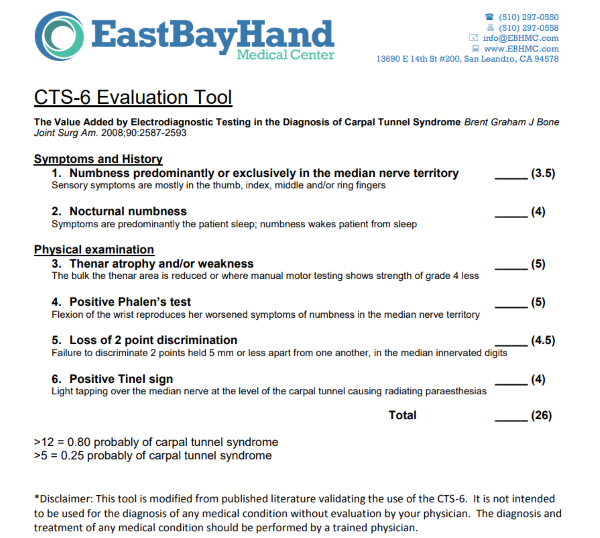
CTS-6 Measure: Click to download
Diagnostic Ultrasound
Diagnostic ultrasound is gaining popularity as a pain-free and easily administered alternative to nerve conduction studies. In a study of 89 patients, Fowler et al. reported ultrasound sensitivity of 89% and specificity of 90%, compared to NCS sensitivity of 89% and specificity of 80%. More recently, a meta-analysis of 1,751 hands evaluated by ultrasound by Miller et al. found ultrasound accuracy comparable to NCS, with high sensitivity and moderate specificity.
Patients consistently report a preference for ultrasound over NCS. Ultrasound is also cost-effective, reduces patient and staff burden, and does not require a separate appointment, making it an efficient diagnostic option.
Scratch-Collapse Test
The scratch-collapse test is a provocative maneuver used to identify nerve compression. The test is positive when stimulation of the skin overlying the affected nerve produces a brief inhibition of muscle activity.
Evidence supporting this test is limited. Jain et al. reported a sensitivity of 29.4% and specificity of 90.4%, while Montgomery et al. found sensitivity as low as 7% and specificity of 78% for CTS. Due to subjectivity, questionable inter-rater reliability, and poor sensitivity, the scratch-collapse test is recommended for screening rather than definitive diagnosis.
The scratch collapse test for carpal tunnel syndrome can be found here:
Video: Scratch Collapse Test for Carpal Tunnel Syndrome
Should We Be Treating CTS With an Orthosis?
According to American Academy of Orthopaedic Surgeons and American Physical Therapy Association practice guidelines, non-operative treatments often do not improve long-term patient-reported outcomes. However, moderate evidence suggests that orthosis use can reduce CTS symptoms. A systematic review by Figueiredo et al. found that wrist orthoses are effective in reducing pain associated with CTS, supporting their role in conservative management.
What Is the Best Way to Position the Wrist?
Effective conservative treatment typically begins with positioning the wrist to reduce pressure on the median nerve. Immobilizing the wrist in a neutral position (0–5° of extension) can decrease symptoms, reduce pain, and improve hand function.
Achieving optimal positioning requires selecting an individualized immobilization approach, either custom-fabricated or prefabricated. Each option has distinct advantages and limitations.
Custom-Fabricated Wrist Orthosis
Advantages
Custom-molded orthoses made from low-temperature thermoplastic material provide a precise and rigid fit. They are individually tailored, making them well suited for patients with small hands, arthritic deformities, or difficulty tolerating prefabricated designs. Their rigidity effectively limits wrist motion that may aggravate symptoms (See Figure 1).
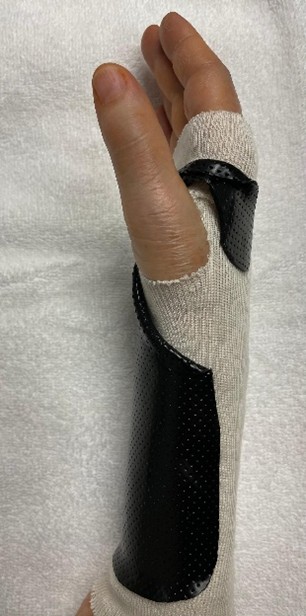
Figure 1: Custom orthosis without the straps to show neutral wrist position.
Disadvantages
Fabrication requires clinical time and a skilled hand therapist. A physician’s order is typically needed for insurance reimbursement. Because of the material’s rigidity, an imperfect fit can cause discomfort. Thermoplastic materials are also non-breathable, and may feel warm or unpleasant, particularly for patients with sensitive skin or in hot climates.
A relevant article discussing local injection therapy paired with splinting in conservative CTS treatment is Zhou T, Wu Z, Gou X, et al. “Local injection therapy for carpal tunnel syndrome: A network meta-analysis of randomized controlled trials.” Front Pharmacol. 2023.
Prefabricated Wrist Orthosis
Advantages
Prefabricated orthoses are cost-effective, readily available in pharmacies or online, and often more comfortable for daily wear due to softer materials. Their lower-profile designs make them suitable for wear during sports or use under clothing.
Disadvantages
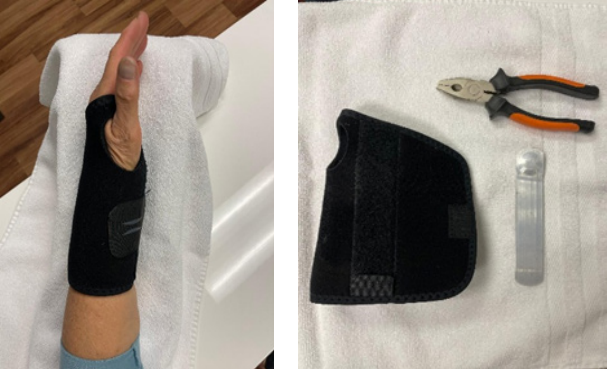
Fit can vary widely, and a poorly fitting orthosis is unlikely to be worn consistently and may also fail to sufficiently limit wrist motion. Some designs do not maintain true neutral wrist positioning. When a metal support bar is included sometimes it may actually increase pressure on the median nerve, requiring adjustment to achieve proper alignment (Figures 2 and 3).
© BraceLab; 2026 all rights reserved
Disclaimer: BraceLab Clinical Pearls are intended to be an informal sharing of practical clinical ideas; not formal evidence-based conclusions of fact.