
Thumb Terminology Confusion

October 2016 No. 42
Thumb Terminology Confusion
by Judy Colditz, OT/L, CHT, FAOTA
Anatomical Descriptors
Anatomical descriptors are based on the anatomical position, making anatomical locations on the hand easily identifiable as dorsal (posterior) and volar (anterior) as well as radial (lateral) and ulnar (medial). Since the thumb does not lie in the same plane as the hand, it is not clear which terms are correct for the thumb. In the illustration below, one can note that the dorsal apsect of the thumb over the metacarpal can also correctly be described as the radial aspect of the hand. (See Figure 1)
The anatomical descriptors of the thumb may be defined as:
•Dorsal: in the same plane as the thumbnail
•Volar: in the same plane as the pulp of the thumb
•Ulnar: on the side of the thumb toward the hand at a right angle to the plane of the thumbnail
•Radial: on the side of the thumb away from the hand at a right angle to the plane of the thumbnail.
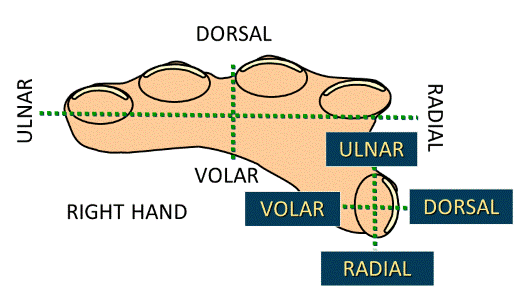
Figure 1: Anatomical descriptors of the hand are different from those of the thumb.
Movement Terminology
Describing thumb movement can be as confusing as describing anatomical locations. Yu, Chase, and Strauch in the Atlas of Hand Anatomy and Clinical Implications (2004) explain how surgical and anatomical terminology differs. As seen in Figure 2 and 3 schematic diagrams (redrawn from Yu, Chase, and Strauch) the term “adduction” can describe a very different direction of movement in each terminology.


Figures 2 and 3: Anatomic and surgical descriptors of thumb movement.
Having been taught the anatomic descriptors, I would like to offer the following definitions to describe thumb motions. It is important to note that these motions describe movement of the entire thumb and not just one joint.
• Adduction: Movement of the thumb toward the second metacarpal (Kaplan, 1984). This definition accommodates both palmar adduction as well as radial adduction (Reid & McGrouther: 1986).
• Abduction: Movement of the thumb away from the second metacarpal (Kaplan, 1984). This definition accommodates both palmar abduction as well as radial abduction (Reid & McGrouther: 1986).
• Flexion: Movement of the thumb perpendicular to plane of thumbnail across and parallel to the palm
• Extension: Movement of the thumb perpendicular to plane of thumbnail away from the hand and parallel to the palm
• Opposition: A combined movement of all thumb joints which rotates the plane of the thumbnail into pronation (Imbriglia, Hagnerg & Baratz: 1996 and Bojsen-Møller: 1976).
It is important to state whether you are describing movement of the entire thumb or movement of a specific thumb joint. Each of the three thumb joints has individual movements and the two most proximal joints have multiple planes of movement!
Although one might expect all hand surgeons have learned and use the surgical terminology, an informal survey did not support this assumption. Similarly, hand therapists do not consistently use the same terminology as surgeons or as other therapists.
We need to adopt precise terminology that is taught and consistently used by all. Such a goal will be long in coming, but the first step is identifying and agreeing on which terminology we will use with our coworkers and our most frequent referral sources.
Thanks to Patricia Rappaport MPT, CHT for editing and comments.
Additional Suggested Reading
Download Clinical Pearl No. 42, Thumb Terminology Confusion, October 2016
© HandLab; 2016 all rights reserved
Disclaimer: HandLab Clinical Pearls are intended to be an informal sharing of practical clinical ideas; not formal evidence-based conclusions of fact.