
A Take-Home Tactile Cue for Accurate Resisted Shoulder External Rotation

February 2020 No. 14
A Take-Home Tactile Cue for Accurate Resisted Shoulder External Rotation
Jerry Ditz, DPT, Dip. Osteopractic, Cert. SMT, Cert. DN
Most patients with shoulder pain have difficulty stabilizing the scapula during external rotation strengthening exercises. How many times have you carefully explained this exercise to a patient only to discover at the follow-up visit they have been doing the exercises improperly? How can you set up your patients for success?
According to an EMG study by Staker: "... muscle activity and joint kinematics can be modified by tactile and verbal guidance. Most improvements in joint positioning and movement occurred with combined guidance during external rotation exercises."(1)
This is good news. Providing patients with both verbal and tactile cues increases the accuracy of performance of an exercise. The challenge is to provide a tactile cue during home exercises. The solution may be to use a resistance band or tube around the patient’s shoulder in addition to a band or tube to provide resistance to external rotation.
First, create a loop on one end of a three-foot piece of resistance tube or band (See figure 1).
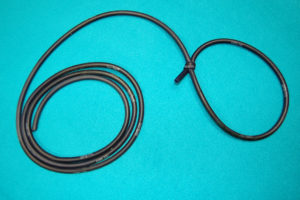
Figure 1: Resistance tube/band
Have the patient place the loop directly around shoulder so the tension of the band/tube pulls the scapulothoracic joint into protraction and slight upward rotation (See figure 2). The patient is instructed to resist the force of the band/tube using the scapulothoracic muscles, pulling in the direction of retraction and downward rotation while performing resistive external rotation. The band/tube may be anchored somewhat differently if the patient is performing external rotation strengthening in a different position.
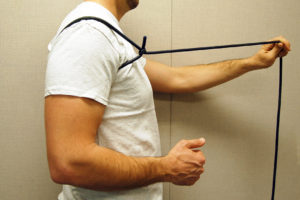
Figure 2: Pulling the scapulothoracic joint into protraction and slight upward rotation
For side-lying external rotation when gravity replaces the resistance tube/band, have the patient use a door as the anchor for the shoulder tube / band (See figure 3). For standing external rotation at 0 degrees of abduction, the band can be held with the patient's uninvolved hand (See figure 4)
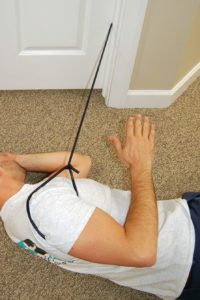
Figure 3: When side lying, patient uses a door to anchor the shoulder tube/band while preforming external rotation against gravity
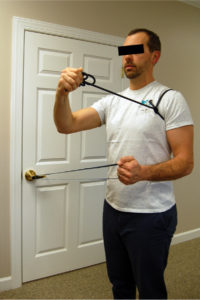
Figure 4: The uninvolved hand can hold the shoulder tube/band when patient is standing
The addition of the shoulder band/tube during resisted external rotation home exercises may provide patients with the tactile cue needed to simultaneously activate the scapulothoracic muscles. This is a simple solution to improve accurate neuromotor re-education for this group of home exercise patients.
References
1. Staker J, Evan A, Jacobs L, Ebert T, Fessler N, Saini G, Ludewig P. The effect of tactile and verbal guidance during scapulothoracic exercises: An EMG and kinematic investigation. J Electromyogr Kinesiol. 2019 Jul 10. pii: S1050-6411(18)30453-X. doi: 10.1016/j.jelekin.2019. 07.004.
© BraceLab 2020 all rights reserved
Disclaimer: BraceLab Clinical Clues are intended to be an informal sharing of practical clinical ideas; not formal evidence-based conclusions of fact.