Functional Ability Determines Exercise Modifications

November 2019 No. 13
Functional Ability Determines Exercise Modifications
Jerry Ditz, DPT, Dip. Osteopractic, Cert. SMT, Cert. DN
In last month’s Clinical Pearl, we discussed the importance of the hand-mind connection in upper extremity rehabilitation. Early joint motion and functional task training is just as important for a lower extremity injury to keep patients from becoming deconditioned and from developing dysfunctional compensatory movement patterns.
Recently, George, a 26-year-old male who sustained a right tibial fracture with peroneal nerve involvement resulting in foot drop, was referred to therapy. Although George was non-weight bearing on his injured leg, it was important to stimulate his motor cortex with functional tasks.
Using a standard chair (18-inch high seat), George was instructed to get up from and sit down on the chair continuously at a comfortable pace, without using his hands, for five minutes.
Because he was non-weight bearing on his injured leg, George initially performed the sit-to-stand exercise in front of a mirror while standing only on the uninvolved leg. This exercise modification stimulated his motor cortex while he also learned correct body mechanics/techniques that would be important for future exercise progressions.
Next, as George began his progression to full weight-bearing, he was unable to tolerate the customary parallel foot position with the sit-to-stand exercise because of pain in his injured leg and because his ankle foot orthosis (AFO) did not allow his right ankle to move into dorsiflexion. To accomplish the sit-to-stand exercise, he was fitted with a Push® AFO on his right leg. The Push AFO provides a dorsiflexion assist while allowing greater passive dorsiflexion and also active plantar flexion, permitting the ankle motion needed for this exercise. He also placed his feet in an off-set position. It is important to note that his left leg was placed in the posterior position in this exercise. Because most of the patient’s weight was on the posterior leg during sit-to-stand, the pain in his injured leg was reduced while still allowing the anterior/injured leg to participate in some weight bearing. This combined strategy allowed George to get up and down from a chair without exhibiting a compensatory technique.
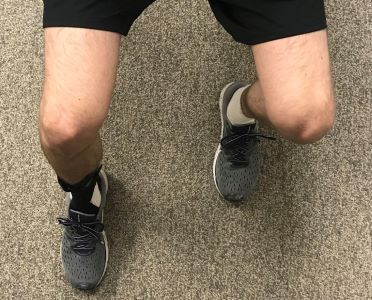
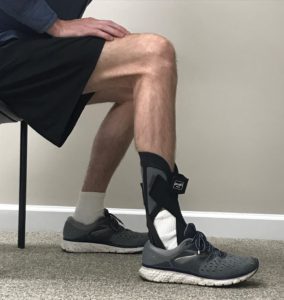
When George progressed to the sit-to-stand exercise using parallel feet placement, he did not initially load equal pressure through each leg. By standing on a balance/rocker board, he was forced to use equal weight distribution during the sit-to-stand exercise. Once he was able to complete this exercise with correct body mechanics and equal leg loading, he progressed to performing the sit-to-stand exercise with off-set feet, but this time the injured (right) leg was in the posterior position of greater weight bearing. Placing more pressure on his injured limb helped him gain confidence in using this leg functionally.
George wanted to return to running. To simulate the weight shift needed during running, his final sit-to-stand exercise modification was standing and sitting using only the involved leg. This exercise proved he could tolerate propelling his entire body weight on his injured leg, which is required during the stance phase of running.
The faster we have patients perform functional tasks, the less likely they are to develop compensatory techniques. For George, using the simple sit-to-stand exercise with a variety of modifications to fit his functional ability, allowed his progression back to normal activities.
Download Clinical Clues No. 13, Functional Ability Determines Exercise Modifications; November 2019
© BraceLab 2019 all rights reserved
Disclaimer: BraceLab Clinical Clues are intended to be an informal sharing of practical clinical ideas; not formal evidence-based conclusions of fact.