
Brace or Boot: How to Decide

Oct. 2024 No. 40
Brace or Boot: How to Decide
by Jerry Ditz, DPT, Dip. Osteopractic, Cert. SMT, Cert. DN
Ankle injuries are common, with lateral ankle sprains and fractures being the most frequent diagnosis. Choosing whether to use an ankle brace or a walking boot depends on several factors which include the injury severity, the patient’s functional needs, and the risk of further injury. The decision of whether the brace or boot is preferable is determined by 1) a review of clinical signs and symptoms, 2) the Ottawa Ankle Rules, and 3) an evaluation of the patient’s gait patterns while using each device.
Clinical Signs and Symptoms Which Guide Treatment
Treatment choices are based on the injury severity:
Mild to Moderate Sprain (Grade I-II):
Mild to moderate sprains represent slight to moderate stretching or tearing of the ligaments. Symptoms include localized swelling, mild pain, and difficulty bearing weight, but the patient typically retains some ankle mobility, allowing limited ambulation.
Treatment: An ankle brace which protects from further inversion while permitting functional mobility is the ideal choice. The brace prevents the complications commonly seen with prolonged immobilization such as muscle atrophy and development of abnormal gait mechanics.
Severe Sprain (Grade III):
A complete ligament tear causes significant swelling, bruising, and ankle instability. Weight-bearing is often very painful, if possible.
Treatment: During the acute phase, a walking boot may be necessary to reduce pain by sufficiently limiting ankle movement. Use of the boot, however, should be limited to the acute phase (less than 10 days), with a transition to a functional ankle brace as soon as possible to restore ankle mobility and avoid complications from prolonged immobilization.
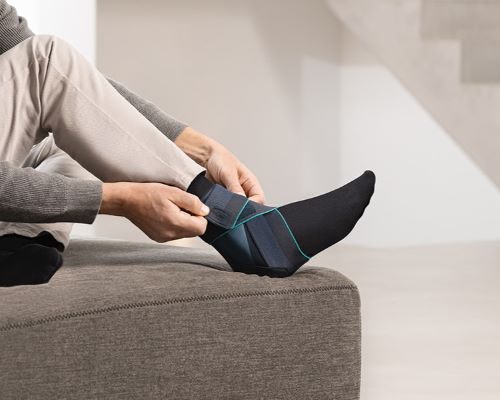
Push med Ankle Brace Aequi Flex
Fracture Risk:
A fracture may be suspected based on the mechanism of injury or the clinical presentation.
Treatment: A suspected fracture should be treated with a walking boot, or a cast may be required to ensure proper healing. Since radiographic imaging guides this decision, the Ottawa Ankle Rules help a clinician determine if imaging is warranted.
The Ottawa Ankle Rules:
A set of guidelines titled the Ottawa Ankle Rules helps clinicians decide when radiographic imaging is needed to rule out a fracture. If any of the following signs are present, an X-ray is recommended:
• Bone tenderness along the distal 6 cm. of the posterior edge of the tibia or fibula.
• Bone tenderness at the tip of the medial or lateral malleolus.
• Inability to bear weight for four steps both immediately after the injury and in the emergency department.
• Bone tenderness at the base of the fifth metatarsal or the navicular bone (may indicate possible midfoot injuries).
If none of these bony areas are tender, the likelihood of a fracture is very low, and an X-ray is usually unnecessary. Reviewing these rules with patients at their initial visit usually decreases their fear of weight bearing on the injury ankle.

Medical Ankle Boot
Clinical Scenario: Gait Patterns with a Walking Boot vs. Ankle Brace
Harriet, a 34-year-old waitress, sustained a Grade III left lateral ankle sprain when stepping off a sidewalk while walking her dog. X-rays taken at the urgent care ruled out a fracture, and she was sent home in a walking boot and crutches and instructed to bear weight as tolerated for six weeks.
After ambulating in the ankle boot for two weeks, Harriet began experiencing right-sided low back pain. Her pain was significant (7/10 pain scale) after only five minutes of ambulation in the boot.
Harriet was informed that grade III lateral ankle sprains typically need to be placed in a walking boot for only 10 days. To determine if she was ready to transition to an ankle brace, we compared her gait and pain levels when wearing the boot versus wearing the brace.
Gait Analysis with the Walking Boot:
Harriet’s gait while wearing the boot revealed a significant alteration in her normal walking pattern. As seen in all patients using a walking boot, the rigid immobilization caused a flat-footed gait with minimal ankle motion. This uneven gait pattern which resembles a leg length discrepancy places strain on the low back and hips.
The walking boot, while necessary to initially protect Harriet’s ankle, resulted in compensatory movements in her lumbar spine and pelvis which led to persistent and significant low back pain. Despite treatment aimed at reducing her back pain, the underlying cause —her altered gait— could not be fully addressed while she remained in the boot.
Gait Analysis with the Ankle Brace:
The ankle brace limited harmful movements such as inversion, while Harriet retained the essential functional ankle motions of dorsiflexion and plantarflexion, thereby obtaining a normal gait cycle.
With her gait returning to normal, Harriet’s secondary symptoms of back and hip pain resolved.
Communication with the Referring Provider
Clear communication with the referring provider is essential to ensure continuity of care, resolve any concerns, and adjust treatment as needed. In Harriet’s case, updates were provided to her referring Urgent Care:
• Confirmation of Ottawa Ankle Rules: Our review of the Ottawa Ankle Rules confirmed the likely absence of a fracture, both confirming and reminding the referring provider of the absence of a fracture.
• Video of gait patterns with boot and with brace: Videos highlighted Harriet’s flat-footed gait and leg length discrepancy when wearing the walking boot, both of which contributed to her back pain. A follow-up video taken after transition to the ankle brace showed improvement in her gait pattern and she reported resolution of her low back pain. Sharing these videos helped her provider understand the functional impact of the treatment and the need to transition to an ankle brace sooner than initially prescribed.
• Pain Levels in Back and Ankle: Initially, while in the boot, Harriet rated her right-sided low back pain as 7/10 and ankle pain as a 2/10. She described aching discomfort in her back after walking more than five minutes in the walking boot. When walking in the brace, her left ankle pain remained at 2/10, and her low back pain subsided to 2/10. This information demonstrated that Harriet’s ankle symptoms were the same as with the support of the walking boot, but that her secondary symptoms were greatly improved when wearing the brace.
Communication with the referring provider allowed adjustment of Harriet’s care plan and confirmed that the transition from a walking boot to an ankle brace promotes a more natural gait, reduces pain, and expedites her overall recovery.
Conclusion
When treating ankle injuries, clinicians must carefully consider the type of injury, the patient’s functional needs, and the impact a boot or brace has on gait. Although the walking boot is useful in the short-term for severe injuries or fractures, transitioning to an appropriate ankle brace is key to restoring normal gait and preventing secondary complications. The Ottawa Ankle Rules serve as an essential guide for deciding when imaging is needed and when it is safe to begin non-surgical treatment. By selecting the appropriate ankle device, patients can recover overall function faster and return to normal activities with minimal gait alteration.