Bracing Beyond Support: Enhancing Proprioception in Lateral Ankle Sprains

June 2025 No. 43
Bracing Beyond Support: Enhancing Proprioception in Lateral Ankle Sprains
by Jerry Ditz, DPT, Dip. Osteopractic, Cert. SMT, Cert. DN
Lateral ankle sprains are among the most common orthopedic injuries, especially in athletic and active populations. While bracing has long been used to prevent excessive joint movement, there is a widespread misconception that braces weaken joints by causing dependency and/or limiting muscle activation. Evidence, however, challenges this view by proving that bracing does not impair long-term strength or proprioception when used appropriately, and especially when integrated with exercise-based rehabilitation.
This Clinical Clue highlights how clinicians are successfully combining bracing and proprioceptive training in real-world rehabilitation programs. This integrated strategy not only improves the mechanical stability of the ankle, but also enhances neuromuscular control, thereby reducing re-injury risk, restoring functional stability, and promoting more confident, efficient movement.
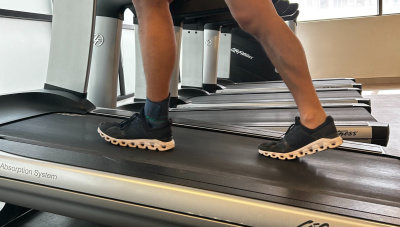
Return to walking on an incline in the Push med Ankle Brace Aequi Flex.
Why Bracing and Proprioceptive Training Work Better Together
Proprioception, the body’s sense of joint position and movement, is disrupted after an ankle sprain and can lead to chronic ankle instability and repeated injuries. Although bracing offers immediate mechanical support, proprioceptive training is necessary to fully restore neuromuscular function.
When used together, bracing and targeted exercises provide a double approach:
1. Bracing supports safe movement and reinforces joint alignment during rehabilitation.
2. Exercise retrains the neuromuscular system to respond more effectively to joint challenges.
If you are curious what this looks like in practice, What I Learned Treating My Own Ankle Sprain illustrates real-world examples of movement retraining. These exercises become even more effective, and safer, when performed within a brace that provides support while allowing dynamic control.

Return to resistance training in the Push ortho Ankle Brace Aequi.
Key Research Advocating the Combined Treatment Approach
1. Kaminski et al. in the Journal of Athletic Training provides a comprehensive evidence-based position statement outlining best practices for preventing lateral ankle sprains. It strongly advocates for a multifaceted prevention program that combines external support (such as bracing) with neuromuscular training. The article provides specific guidance on effective exercise strategies, including:
• Balance and Postural Control Training: Exercises like single-leg stance on foam pads or wobble boards to restore joint position sense and improve control during dynamic movement.
• Dynamic Stability Drills: Tasks that include forward/backward hops, side-to-side jumps, and agility ladder drills to replicate real-life and sport-specific movements.
• Movement Retraining: Reinforcement of proper landing mechanics and cutting techniques to reduce high-risk ankle positions during athletic tasks.
• Progressive Complexity: Changing training environments to progress from stable to unstable surfaces, and from slow to rapid movements, so as to challenge the neuromuscular system in functional ways.
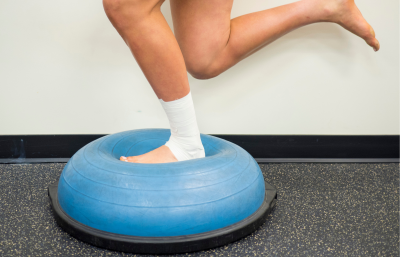
Return to balancing on a dynamic surface with ankle taped and Bosu ball.
Conclusion: Ankle bracing provides critical external support, but when paired with a structured, progressive neuromuscular training program, it can dramatically reduce the likelihood of first time and recurrent ankle sprains. This integrated approach is supported as best practice for both prevention and rehabilitation.
2. Burger et al. in the Journal of Back and Musculoskeletal Rehabilitation provide a systematic review which analyzes studies comparing the outcomes of bracing, proprioceptive training, and the combination of both. One of the highlighted protocols includes an 8-week home-based neuromuscular exercise program with:
• Wobbleboard training
• Progressions from double-leg to single-leg tasks
• Sport-specific drills (e.g., cutting, pivoting)
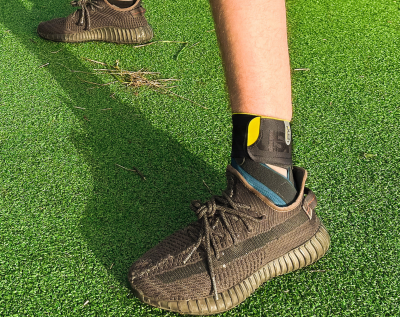
Return to agility training in Push Sports Ankle Brace Kicx
Conclusion: Bracing in addition to exercise was more effective than either intervention alone for preventing ankle re-injury in athletes.
Consider how this approach translates to everyday clinical settings in our article The Ankle Sprain Epidemic: How Can We Help? Incorporating a properly chosen ankle brace can significantly increase patient compliance and comfort as they progress through this proprioceptive work.
3. De Vasconcelos et al. in Clinical Rehabilitation offers a meta-analysis assessing interventions aimed at reducing ankle sprain incidence. While not all included studies used bracing, those that did along with balance exercises (like the Star Excursion Balance Test and single-leg training) showed the greatest improvements in neuromuscular control and injury reduction.
Conclusion: Bracing enables earlier and safer introduction of challenging balance tasks which are crucial for proprioceptive gains.
From these references the clinical implications are clear:
• Ankle bracing is valuable early in rehabilitation to provide safety and prevent excessive motion.
• Proprioceptive training restores joint awareness, control, and balance.
• Combined use of ankle bracing and exercise results in better outcomes than either approach alone.
Not Just Support; Smart Recovery
Ankle braces are no longer just passive stabilizers, but many are now sophisticated designs made with innovative materials and based on biomechanical principles. When used alongside targeted proprioceptive exercises, these braces become active partners in neuromuscular retraining. This integrated approach supports safe movement, accelerates recovery, and reduces re-injury which helps patients not just return to activity, but to return safely and confidently.
Download Clinical Clue No. 43, Bracing Beyond Support: Enhancing Proprioception in Lateral Ankle Sprains, June 2025
© BraceLab; 2025 all rights reserved
Disclaimer: BraceLab Clinical Pearls are intended to be an informal sharing of practical clinical ideas; not formal evidence-based conclusions of fact.