
Knee Brace for Pain vs Knee Brace for ACL Injury: How to Choose the Right Support
|
Knee Brace for Pain vs Knee Brace for ACL Injury: How to Choose the Right Support |
You've searched for a knee brace, and now you're staring at dozens of options that all claim to do the same thing.
Some are soft sleeves. Some have rigid hinges.
Some are marketed for sport, others for everyday wear, and a handful seem to promise everything at once. It's a lot to sort through, especially when you're already dealing with pain or recovering from an injury.
Here's the thing: the brace that works for someone managing arthritis is not the same brace that works for someone rebuilding stability after an ACL tear. And choosing the wrong one doesn't just mean wasted money.
It can mean wearing something that fails to address your actual problem, or worse, something that gives you false confidence in a joint that needs proper support.
This guide cuts through the noise. We'll walk through the main categories of knee braces, the specific conditions they're designed for, and how to match your situation to the right product.
Whether you're dealing with everyday knee pain, a tendon problem, or you're working your way back from ACL surgery, there's a clear path forward. You just need to know where to start.
Understanding the Knee and Why Support Type Matters
The knee is one of the most mechanically complex joints in the body. It doesn't just hinge open and closed. It also rotates slightly as it moves, and it relies on a network of four major ligaments, multiple tendons, cartilage surfaces, and surrounding muscle to stay stable under load.
When something breaks down in that system, the type of problem matters enormously:
- Cartilage wear causes pain and inflammation but doesn't usually destabilise the joint
- Kneecap tracking problems cause pain at the front of the knee, particularly on stairs or after sitting
- Tendon irritation causes localised pain just above or below the kneecap, especially during activity
- Ligament damage, particularly to the ACL, removes the structural stability the joint depends on
A brace designed for patella pain applies targeted pressure to a specific structure. A brace designed for ligament instability uses hinges and rigid supports to control the joint mechanically. These are fundamentally different tools. Using one in place of the other is like using a bandage when you need a splint.
So before choosing anything, you need to understand which category your knee problem falls into.
Knee Braces for Pain: What They Are and When You Need One
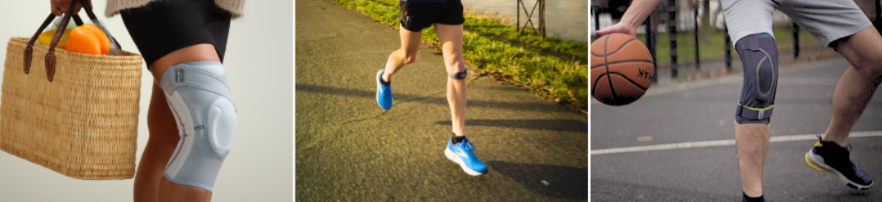
When people search for a knee brace for pain, they're usually dealing with a condition where the joint still has reasonable structural integrity, but something within it is inflamed, worn, or irritated. The goal of the brace isn't to hold the knee together. It's to reduce load on the painful area, improve kneecap tracking, or provide compression that calms inflammation and sharpens proprioception (your body's sense of where the joint is in space).
Common Conditions That Call for a Pain-Focused Brace
Osteoarthritis and rheumatoid arthritis are among the most common reasons people reach for knee support. In these conditions, cartilage has thinned or degraded, and the joint surfaces create friction and pain with movement. A well-fitted brace offloads pressure from the affected compartment and can meaningfully reduce pain during daily activity.
Patellofemoral pain syndrome, often called runner's knee, develops when the kneecap doesn't track correctly through the groove at the front of the femur. This creates pain at the front of the knee, especially going up stairs, squatting, or sitting for long periods. A patella-stabilising brace helps guide the kneecap back into alignment.
Patellar tendonitis and jumper's knee involve inflammation of the patellar tendon, the thick band of tissue connecting the kneecap to the shin. Repeated jumping, running, or impact loads stress this tendon over time. A targeted patella brace applies controlled pressure directly to the tendon, which reduces pain signals and lessens the mechanical load during movement.
Osgood-Schlatter disease is common in adolescents during growth spurts. It causes pain and a bony prominence just below the kneecap where the patellar tendon attaches to the tibia. A patella brace can reduce tendon stress and help young athletes stay active during this phase.
Mild collateral ligament instability can develop after a minor sprain or with general joint laxity. The knee doesn't feel fully reliable when changing direction, but the damage isn't severe enough to require surgical intervention. A hinged brace with medial-lateral support addresses this effectively.
Choosing the Right Brace for Your Pain Condition
For Arthritis, Post-Injury Instability, and General Knee Pain
|
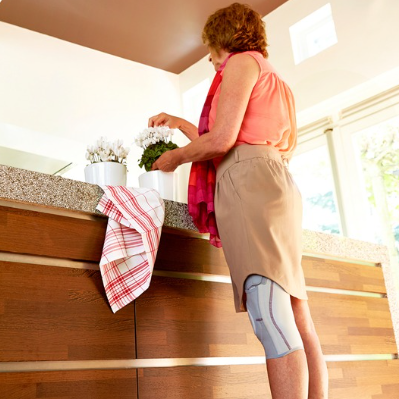
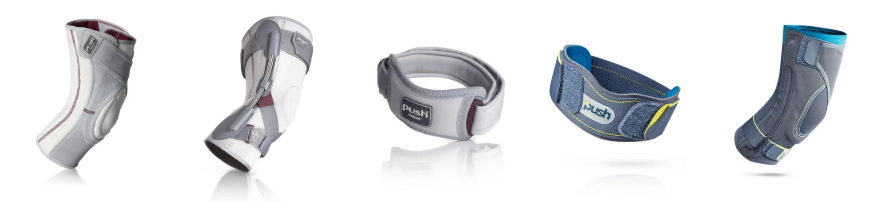
The Push care Knee Brace is designed for everyday use. It's lightweight and uses an open thigh design that lets you step into it easily, which matters if bending down to put on a brace is itself uncomfortable. It controls upward kneecap movement and supports the patella on both sides using a U-shaped pad. Internal silicone strips prevent it from migrating down the leg throughout the day. The Sympress microfiber lining is soft and breathable, so wearing it for hours doesn't become irritating. This is the right choice for people managing arthritis, patellofemoral pain, or mild instability across everyday activities like walking, standing, driving, and light exercise. |
|
|
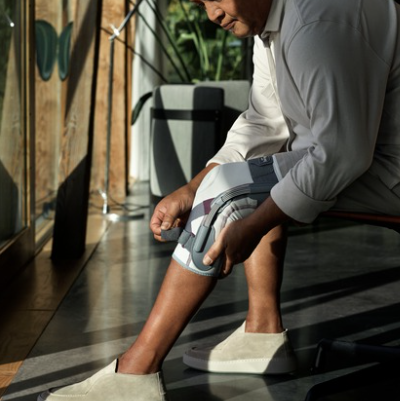
For more significant conditions, where instability is more noticeable, where you've had a prior knee injury, or where you're in a protective phase following surgery, the Push med Knee Braceprovides a higher level of support. It uses non-axial leaf-spring hinges that follow the knee's natural rotational axis rather than working on a fixed point. This is an important distinction: most hinged braces operate on a fixed axis, which doesn't precisely match how the knee actually moves. The non-axial design reduces friction during movement and provides more accurate medial-lateral support. It's slim enough to wear under clothing, uses the same Sympress lining, and is clinically indicated for OA, RA, post-trauma instability, and post-surgical protection. |
|
For Patellar Tendon Pain Specifically
If jumper's knee, runner's knee, or Osgood-Schlatter is your primary issue, a full sleeve brace often isn't the most targeted solution. What you need is a brace that applies direct, controlled pressure to the patellar tendon.
|
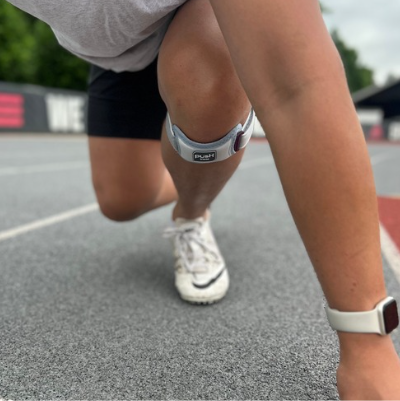
The Push med Patella Brace uses an anatomically shaped viscoelastic polymer pad, not a generic foam insert, combined with a semi-rigid reinforcement strap that distributes pressure evenly along the tendon. One size fits knee circumferences from 27 to 45 cm. It's more clinically precise than most straps on the market and suits everyone from people doing light daily activity through to those playing recreational sport. |
|
|
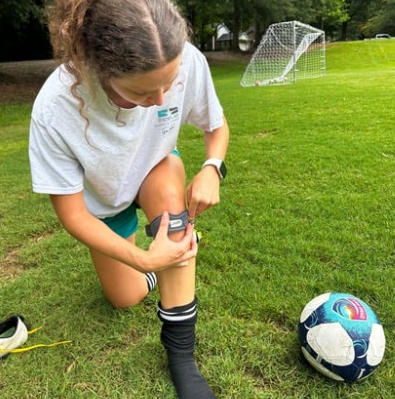
For athletes or anyone who wants the same support in a lighter, more competition-ready format, the Push Sports Patella Brace is the better fit. The pad uses resilient foam rather than viscoelastic polymer, which keeps the profile slim and the feel agile. An anti-slip design keeps it in place even during sweaty activity, and minimal material behind the knee means deep bending doesn't become restricted. One size, latex-free, and machine washable. |
|
Knee Braces for ACL Injury: What They Are and When You Need One
ACL injuries belong in a separate category entirely. The anterior cruciate ligament provides rotational stability and prevents the tibia from sliding forward relative to the femur. When it's torn, either partially or fully, that structural stability disappears. The knee may feel like it gives way, especially when changing direction, landing from a jump, or decelerating.
In the acute phase after an ACL tear, and particularly after reconstruction surgery, bracing is typically prescribed and managed by a clinician. Post-operative ACL braces are often bulkier, sometimes custom-fitted, and set to specific ranges of motion that change as healing progresses. That phase isn't something to navigate with an off-the-shelf product.
However, there's a later phase of ACL recovery where general-purpose braces become genuinely relevant.
End-Stage ACL Rehab and Return to Sport
Once you're several months post-surgery, strength has substantially returned, and your physiotherapist or surgeon has cleared you to progress toward sport, the priority shifts. You're no longer protecting a healing graft. You're rebuilding confidence, managing residual instability, and protecting the joint during the high-demand movements that sport involves.
This is where a knee brace for ACL injury intersects with what an over-the-counter functional brace can offer.
The Push Sports Knee Brace is specifically indicated for end-stage ACL rehab and return-to-sport protection. It uses the same non-axial leaf-spring hinge system as the Push med Knee Brace, positioned close to the joint, providing medial-lateral support while allowing full, unrestricted flexion. A U-shaped pad stabilises the kneecap on both sides, making it one of the more versatile options in the range.
This brace is suited to:
- Athletes returning to ball sports, running, skiing, or racquet sports after ACL rehab
- People with mild collateral ligament instability alongside patellofemoral concerns
- Anyone who needs structural knee support without the bulk of a rigid brace interfering with movement
To be clear: the Push Sports Knee Brace is not a substitute for a prescribed ACL brace in the acute or early post-surgical phase. If you've recently had ACL reconstruction, follow your clinician's guidance for that stage. But when you're cleared to return to training and want ongoing joint support through activity, this is a well-designed, clinically considered option.
Knee Brace for Pain vs Knee Brace for ACL Injury: A Direct Comparison
The table below summarises the key differences across conditions, recommended braces, and the features that matter most for each situation.
| Condition | Recommended Brace | Key Feature |
|---|---|---|
| Everyday arthritis, mild instability | Push care Knee Brace | Lightweight, step-in design, patella control, Sympress lining |
| Moderate instability, OA, post-injury, post-op | Push med Knee Brace | Non-axial hinges, medial-lateral stability, low profile under clothing |
| Patellar tendon pain, jumper's knee, Osgood-Schlatter | Push med Patella Brace | Viscoelastic polymer pad, semi-rigid strap, even pressure distribution |
| Athletic patellar tendon pain | Push Sports Patella Brace Push med Patella Brace |
Slim foam pad, anti-slip design, unrestricted deep flexion |
| End-stage ACL rehab, return to sport | Push Sports Knee Brace | Non-axial hinges, patella stabilisation, full unrestricted flexion |
How to Choose the Right Brace for Your Situation
Beyond the specific condition, a few practical questions help narrow things down further.
How Active Are You?
If you're mainly doing everyday activities like walking, housework, or light gardening, a care-level brace is usually the right starting point. If you're running, playing sport, or working your way back to training, a sports-grade option with hinge technology and anti-slip performance is more appropriate.
Where Exactly Is the Pain?
Front of the knee around or just below the kneecap? A patella brace may be all you need. Sides of the knee, with a sense of instability when you turn or pivot? A hinged brace with medial-lateral support is the better fit. Diffuse pain with arthritis or general swelling? A full-coverage hinged sleeve addresses that more completely.
Have You Had Surgery?
If yes, always follow your clinician's guidance first, particularly in the acute and early recovery phases. Once you're in the maintenance or return-to-sport phase and have been cleared to progress, a functional brace like the Push Sports Knee Brace or the Push med Knee Brace becomes a useful tool for ongoing protection.
Does Discretion Under Clothing Matter?
If wearing the brace visibly or having it show under clothing is a concern, there's no need to worry. All BraceLab braces are low-profile and made for everyday use.
Are You Using HSA or FSA Funds?
All braces in the Push range available through BraceLab are HSA/FSA eligible. If you're managing healthcare costs through a health spending account, that's covered.
Getting the Fit Right
Even the best brace won't perform well if the sizing is off. Too loose and it migrates down the leg during activity. Too tight and it restricts circulation or creates pressure points.
All Push braces come with clear sizing guides based on knee circumference measurements taken at specific points. The internal silicone strips in the hinged braces add a further layer of security against slippage during movement.
If you're unsure about sizing or which option suits your specific situation, visit BraceLab for detailed product pages, sizing guides, and clinical information. Or if you'd prefer to talk it through, contact us directly.
Conclusion
Choosing between a knee brace for pain and a knee brace for ACL injury comes down to understanding what your knee actually needs. Pain from arthritis or tendonitis calls for comfort, compression, and targeted support. Ligament instability or ACL recovery calls for structural stability and hinge technology that respects the knee's natural movement.
Get that distinction right, and you'll get far more out of your brace. Whether you're managing a chronic condition, healing from an injury, or getting back to sport, there's a specific option in the Push range built for exactly where you are.
Frequently Asked Questions
Can I wear a knee brace for pain if I also have a mild ACL sprain?
A partial ACL sprain without significant instability may respond well to a hinged brace like the Push med Knee Brace, which provides medial-lateral support and follows the knee's natural movement. However, any suspected ligament injury should be evaluated by a clinician first. What feels like a mild sprain can sometimes involve more structural damage than the initial symptoms suggest.
How long should I wear a knee brace each day?
This depends on your condition and activity level. For arthritis or patellofemoral pain, many people wear their brace during activity and remove it when resting. For post-injury protection or return-to-sport rehab, your physiotherapist may recommend wearing it throughout the day initially. There's no universal rule. Start with wearing it during the activities that provoke your symptoms and adjust from there.
Will a knee brace weaken my muscles over time?
This is a common concern and worth addressing directly. Research does not consistently support the idea that wearing a well-fitted brace causes muscle weakness, particularly when you remain active while wearing it. Problems arise when people use bracing as a substitute for rehabilitation rather than alongside it. A brace is a support tool, not a replacement for strengthening the muscles around the knee.
Is there a difference between a compression sleeve and a hinged knee brace?
Yes, a meaningful one. A compression sleeve provides warmth, mild compression, and proprioceptive feedback. It's useful for mild swelling, general knee awareness, or low-level discomfort. A hinged brace provides mechanical support to the medial and lateral sides of the joint and is necessary when there is actual instability or ligament involvement. For most of the conditions covered in this guide, a hinged option will be more effective.
Can I wear a knee brace during sport?
Yes, provided it's designed for that purpose. The Push Sports Knee Brace and Push Sports Patella Brace are both built specifically for use during physical activity, including running, ball sports, and racquet sports. The anti-slip designs and streamlined profiles mean they stay in place and don't interfere with movement.
Do I need a prescription to buy a knee brace?
No. All braces available through BraceLab can be purchased without a prescription. However, if you have a significant injury, have had surgery, or are unsure about your diagnosis, getting a clinical assessment before choosing a brace is always worthwhile. A physiotherapist or orthopaedic specialist can help confirm what you're dealing with and whether a specific brace is appropriate.
Are these braces covered by HSA or FSA?
Yes. All Push braces available through BraceLab are HSA/FSA eligible, so you can use your health spending account to cover the purchase.