
What Is the Difference Between a High Ankle Sprain and a Regular One?

|
What Is the Difference Between a High Ankle Sprain and a Regular One? |
Not all ankle sprains are the same. Two people can both be diagnosed with an ankle sprain but experience very different symptoms, recovery times, and challenges getting back to normal activity. One reason is that a high ankle sprain and a regular ankle sprain affect different ligaments and typically occur through different types of movement.
A regular ankle sprain, usually a lateral ankle sprain, affects the ligaments on the outside of the ankle. A high ankle sprain, also called a syndesmotic ankle sprain, affects the ligaments that connect the tibia and fibula just above the ankle. Because these injuries involve different structures, where you feel pain, which movements aggravate it, and how long recovery takes can also differ.
Below, we'll explain the difference between a high ankle sprain and a regular ankle sprain, including how each injury happens, common symptoms, typical recovery considerations, and the type of support you may need as you return to walking, exercise, and sport.
Where Each Injury Happens
A Lateral Ankle Sprain Damages the Outside Ligaments
|
A lateral ankle sprain is the most common type of ankle injury, accounting for roughly 85% of all ankle sprains. They are also far more common than most people assume: research indexed by the National Institutes of Health estimates that more than 23,000 ankle sprains happen every day in the United States, about one in every 10,000 people. A lateral sprain happens when the foot rolls inward underneath you, stretching the ligaments along the outer ankle. The anterior talofibular ligament, the small band at the front of the outer ankle, is usually the first to give. |

|
The pain sits on the outside of the ankle, often just in front of the bony bump. Swelling appears quickly, and bruising may follow over the next day or two. If you press gently along the outer ankle, the sorest point is usually easy to pinpoint with a single finger, which is one of the ways a clinician tells a lateral sprain from a high ankle sprain.
A High Ankle Sprain Damages the Ligaments Above the Joint
|
A high ankle sprain injures the syndesmosis, the set of ligaments binding the tibia and fibula together just above the ankle. Those two bones form the socket the ankle moves in, and the syndesmosis is what keeps that socket tight. A high ankle sprain usually happens when the leg twists, not when the ankle simply rolls. The foot stays planted on the ground while the body keeps turning over it. That is why these injuries show up most in sports where players change direction with the foot fixed. |

|
In athletes, high ankle sprains account for 11% to 17% of ankle sprains, and in contact sports such as football, hockey, and lacrosse that figure rises to between 31% and 74%. The pain sits higher than it does with a lateral sprain, above the ankle joint rather than below it, and it can run several inches up the shin.
How the Two Feel Different
The clearest differences show up in where it hurts and what makes it hurt.
| Lateral (regular) ankle sprain | High ankle sprain | |
| Pain location | Below and in front of the outer ankle bone | Above the joint line, between the two lower leg bones |
| Swelling pattern | Swells quickly and visibly around the outer ankle | Often swells less dramatically, which is part of why these get underestimated |
| What aggravates it | Rolling the foot inward | Rotating the foot outward, or pushing off to change direction |
| Walking | Many people walk, carefully, on a mild sprain within a few days | Tends to hurt through the push-off phase of every step, which makes normal walking hard for longer |
| Recovery time | A mild sprain often settles within two to four weeks | Commonly takes six to eight weeks or more, and severe ones can need surgical fixation |
Recovery time is where the distinction matters most. Treating a high ankle sprain on a lateral sprain timeline means returning to sport before the syndesmosis is ready.
Why a High Ankle Sprain Takes Longer to Heal
The syndesmosis is a load-bearing connection, not a stabilizer at the edge of a joint. Every step drives the talus, the ankle bone that sits between your heel and your two lower leg bones, up between the tibia and fibula, and those two bones spread slightly to accommodate it. The syndesmotic ligaments resist that spread.
When those ligaments are injured, that resistance is reduced, and the bones separate a little more than they should under load.
This is why high ankle sprains are usually managed with a period of protected weight-bearing, and why a clinician will often image the ankle to check whether the two bones have shifted apart.
When to Get It Assessed
Any ankle injury that stops you weight-bearing deserves professional assessment. These signs point toward a syndesmotic injury or a fracture rather than a straightforward sprain.
- Pain above the ankle joint rather than below it, especially if it runs up the shin
- Pain when the foot is rotated outward, or when someone squeezes the calf just below the knee
- Inability to put weight through the foot, or a clear inability to take four steps
- Tenderness directly over the bone rather than over soft tissue
- An ankle that still hurts through push-off after two weeks of sensible self-care
A sports medicine physician, physical therapist, or orthopedic clinician can tell a lateral sprain from a high ankle sprain with a physical examination and imaging if needed. Getting that answer early changes the plan, because each injury needs a different timeline and a different approach to loading.
Lateral Sprain and High Ankle Sprain Support Needs
For a Lateral Ankle Sprain
With a lateral ankle sprain, the goal is to protect the injured ligaments as they heal and reduce the risk of rolling the ankle again as you return to walking, exercise, and sport. External support can help provide stability while allowing a gradual return to activity.
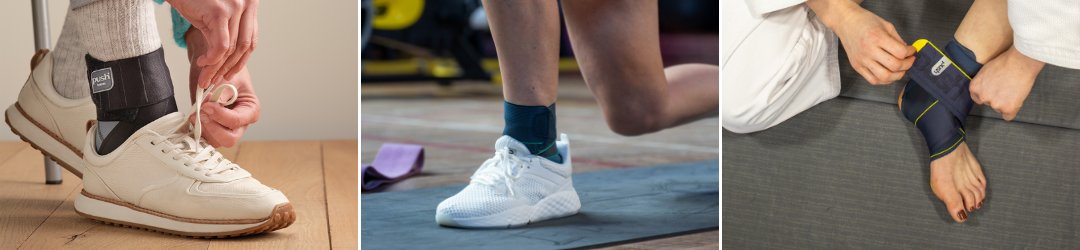
The Push med Ankle Brace Aequi Flex is indicated for lateral ankle sprains, sprain prevention, and moderate to severe chronic ankle instability. Its supportive shell surrounds the lower leg, ankle, and heel, while a diagonal strap system helps control unwanted ankle movement and provides adjustable compression.

Continued support can be especially important after the initial injury. Research indexed by the National Institutes of Health reports that up to 75% of people who sustain a lateral ankle sprain may experience recurrent sprains or persistent symptoms. BraceLab recommends wearing the Aequi Flex for up to a year after injury to help reduce the risk of reinjury as you return to normal activity and sport.
For a High Ankle Sprain
Syndesmotic injuries are managed by a clinician, and the plan depends on whether the tibia and fibula have separated. Mild cases are usually protected in a boot or a rigid device for a period, followed by a structured return to loading. More significant separations may need surgical stabilization.
Because high ankle sprains can vary significantly in severity, a healthcare professional should determine when and how you return to weight-bearing, exercise, and sport. Once you are cleared to progress, your clinician may recommend external ankle support as part of your return-to-activity plan. For injuries that require surgical treatment or more structured stabilization, you can also explore our post-op ankle braces designed to provide support during recovery.
Preventing the Next Ankle Sprain
A previous ankle sprain can increase your risk of another injury, particularly if strength, balance, and proprioception, your body's ability to sense the position and movement of the joint, have not fully recovered. That is why feeling better is not always the same as being ready to return to full activity. Rehabilitation can help restore these functions and reduce the risk of another ankle sprain.
Strategies for preventing recurrent ankle sprains may include:
- Balance and proprioception exercises, beginning with single-leg balance and progressing to more challenging surfaces and sport-specific movements
- Calf and ankle strengthening to improve muscular support and control around the joint
- Ankle bracing during higher-risk activities, particularly sports that involve cutting, jumping, landing, or rapid changes in direction
- Appropriate footwear for your activity and playing surface, with worn shoes replaced as needed
If your ankle has rolled more than once, or seems to give way even on level ground, our guide to why ankles keep rolling explains some of the factors behind recurrent ankle sprains and chronic ankle instability.

Key Takeaways
- A lateral ankle sprain, the most common type, injures the ligaments on the outside of the ankle, below the joint. A high ankle sprain injures the syndesmosis, which binds the two lower leg bones together above the joint.
- Lateral sprains come from the foot rolling inward. High ankle sprains usually come from the leg rotating over a planted foot, which is why they are common in field and court sports.
- Pain below the outer ankle bone points to a lateral sprain. Pain above the joint line, or pain when the foot is rotated outward, points to a high ankle sprain.
- A mild lateral sprain often settles in two to four weeks. A high ankle sprain commonly takes six to eight weeks or longer, and needs clinical guidance on loading.
- The Push med Ankle Brace Aequi Flex is indicated for lateral ankle sprains, sprain prevention, and chronic ankle instability, and BraceLab recommends wearing it for up to a year after injury to help prevent recurrence.
- If you cannot bear weight, or the pain sits above the joint, get the ankle assessed before self-treating.
Frequently Asked Questions
How can I tell at home whether my sprain is high or low?
Location is the best clue. Press gently above the ankle joint, between the two lower leg bones. If that spot is more tender than the area below and in front of the outer ankle bone, a high ankle sprain is more likely. Pain when someone gently rotates your foot outward points the same way. This is a guide, not a diagnosis, so confirm it with a clinician.
Can I walk on a high ankle sprain?
Some people can, but walking loads the injured ligaments with every push-off, and resisting that load is their job. That is why protected weight-bearing is common in the early stage. Ask your clinician how much loading is appropriate rather than judging it by pain alone.
Does an ankle brace help a high ankle sprain?
Early management usually calls for something more protective than a functional brace, and the decision belongs with your clinician. A brace often has a role later, during the return to sport, once the syndesmosis has healed enough to tolerate loading.
How long should I wear a brace after a normal ankle sprain?
Longer than most people expect. BraceLab's guidance for the Aequi Flex is that it can be worn up to a year after injury to help prevent recurring sprains. Ligament tissue regains its strength gradually, and reinjury risk stays elevated well after the pain has gone.
Why do I keep spraining the same ankle?
Repeat sprains usually reflect reduced proprioception and residual laxity rather than bad luck. Balance training rebuilds the first, and bracing during high-risk activity manages the second while you do.
Can a high ankle sprain happen without a big injury?
Yes. A high ankle sprain typically occurs when the foot is planted and the leg or body twists, but the injury does not always look or feel severe when it happens. You may be able to keep walking, and swelling or bruising may be less noticeable than with a typical lateral ankle sprain. If you have pain above the ankle after a twisting injury, especially pain that worsens with walking, pushing off, or rotating the foot, it is worth having the injury evaluated by a healthcare professional.
Find the Right Ankle Support for Your Injury
If you are managing a lateral sprain or the instability that follows one, the right brace protects the joint while you keep moving. Explore the BraceLab ankle brace collection to compare options, see the Push med Ankle Brace Aequi Flex alongside the rest of the range, and find your size. For clinician-designed braces across every joint, browse BraceLab.
Conclusion
A sprained ankle is not a single diagnosis. The common lateral sprain and the less common high ankle sprain damage different tissue, respond to different movements, and follow different recovery curves. Knowing which one you have changes how long you protect it and how soon you return to sport.
If your pain sits above the ankle joint, hurts through push-off, or has not improved on the timeline you expected, that is worth having assessed. And once you know what you are dealing with, supporting the joint properly through the return to activity is what keeps a single sprain from becoming a pattern.